


The way we understand and develop communities is undergoing a fundamental transformation. Gone are the days when city planners relied on outdated census reports and anecdotal evidence to make multi-million dollar infrastructure decisions. Today’s most successful communities are powered by something far more sophisticated: hyperlocal data intelligence.
This shift isn’t just about having more information—it’s about democratizing access to community insights that were previously locked away in government databases or buried in technical reports that only specialists could interpret. The result? More equitable, evidence-based decision-making that actually reflects the lived experiences of residents.
The Million Dollar Challenge
Here’s a staggering fact: American communities receive millions through programs like Community Development Block Grants, Low-Income Housing Tax Credits, and Small Business Administration lending. Yet most of this investment happens without comprehensive neighborhood-level intelligence about where it will have the greatest impact.
Federal agencies face one of their biggest challenges when determining how to best access, store, govern and present the complex and voluminous data sets in their possession. The World Economic Forum predicts that the amount of data generated daily will reach 463 exabytes by 2025.
The cost of this disconnect is measured in missed opportunities: affordable housing built in areas that lack transportation access, small business loans deployed without understanding local market conditions, and infrastructure investments that don’t address the most pressing community needs.
Breaking down these data silos requires more than new technology—it demands a fundamental rethinking of how organizations collect, process, and share information. The most successful community development initiatives are those that modernize their entire data workflow, from initial collection through final decision-making, creating seamless connections between previously isolated systems.
The Rise of the 15-Minute City
The COVID-19 pandemic accelerated a global movement toward more localized, human-centered urban planning. The “15-minute city” concept—where residents can access most daily necessities within a 15-minute walk or bike ride from their homes—has been embraced by cities from Paris to Portland as a framework for sustainable, equitable development.
But here’s the challenge: you can’t build a 15-minute city without 15-minute data. Planners need to understand not just where services exist, but how accessible they are to different demographic groups, how they’re changing over time, and where gaps present the greatest opportunities for improvement.
Consider the complexity: a grocery store might be within a 15-minute walk for an able-bodied adult, but effectively inaccessible to a parent with young children if it requires crossing dangerous intersections. Traditional planning data can’t capture these nuances—but sophisticated neighborhood analytics can.
This is why forward-thinking cities are investing heavily in hyperlocal data infrastructure. Washington D.C. recently launched a comprehensive “Built Environment Indicators” mapping tool that visualizes neighborhood access to everything from healthcare and education to green spaces and public safety resources. The tool doesn’t just show where services exist—it analyzes how well connected communities are to the amenities that determine quality of life.
The key to D.C.’s success wasn’t just building a new platform—it was reimagining how multiple city departments collaborate and share data. This required updating legacy systems, training staff on new workflows, and creating governance structures that ensure data quality while maintaining accessibility. The result is a model that other cities are now eager to replicate.
Impact Investing Goes Hyperlocal
The private sector is equally hungry for neighborhood-level intelligence. Impact investing—investments made with the intention of generating positive social and environmental outcomes alongside financial returns—has grown to represent over $1.57 trillion in global assets under management.
These investors are increasingly focused on place-based strategies that address community-specific challenges. But identifying the right opportunities requires understanding local market dynamics at a granular level that traditional investment analysis can’t provide.
Community Development Financial Institutions (CDFIs), which specialize in providing capital to underserved communities, are particularly dependent on hyperlocal data. They need to understand not just current neighborhood conditions, but how communities are changing over time and which interventions are most likely to generate lasting positive impact.
The most sophisticated impact investors are moving beyond simple demographic analysis toward what we might call “community intelligence platforms“—comprehensive, real-time understanding of local economic conditions, social dynamics, and development opportunities. This requires integrating data from dozens of sources: census records, business licensing databases, real estate transactions, infrastructure investments, and even anonymized consumer spending patterns.
Successfully implementing these platforms requires organizations to modernize their entire analytical workflow. This means moving from quarterly reports based on months-old data to dynamic dashboards that update in real-time, replacing manual data collection with automated feeds, and training teams to make decisions based on predictive analytics rather than historical trends.
“The biggest challenge we see with neighborhood data isn’t technical—it’s organizational. Cities and community groups have access to incredible datasets, but they’re still making decisions based on outdated spreadsheets and quarterly reports. When we help organizations modernize their entire data workflow, from collection to visualization to decision-making, that’s when we see real transformation happen. The Inclusive Growth Score™ is a perfect example—it’s not just about building dashboards; it’s about changing how communities understand themselves.”
The Privacy Paradox
One of the biggest challenges in developing neighborhood-level data platforms is balancing transparency with privacy. Communities deserve access to data about their own neighborhoods, but individuals also deserve protection from surveillance and discrimination.
The solution lies in sophisticated data governance frameworks that maximize analytical value while minimizing privacy risks. This means working with aggregated, anonymized datasets rather than individual records, implementing strong security protocols, and maintaining transparency about data sources and methodologies.
Leading financial institutions are pioneering approaches that leverage massive transaction datasets to generate community insights while maintaining strict privacy protections. Advanced anonymization techniques and aggregated analysis methods show that it’s possible to provide actionable neighborhood intelligence without compromising individual privacy.
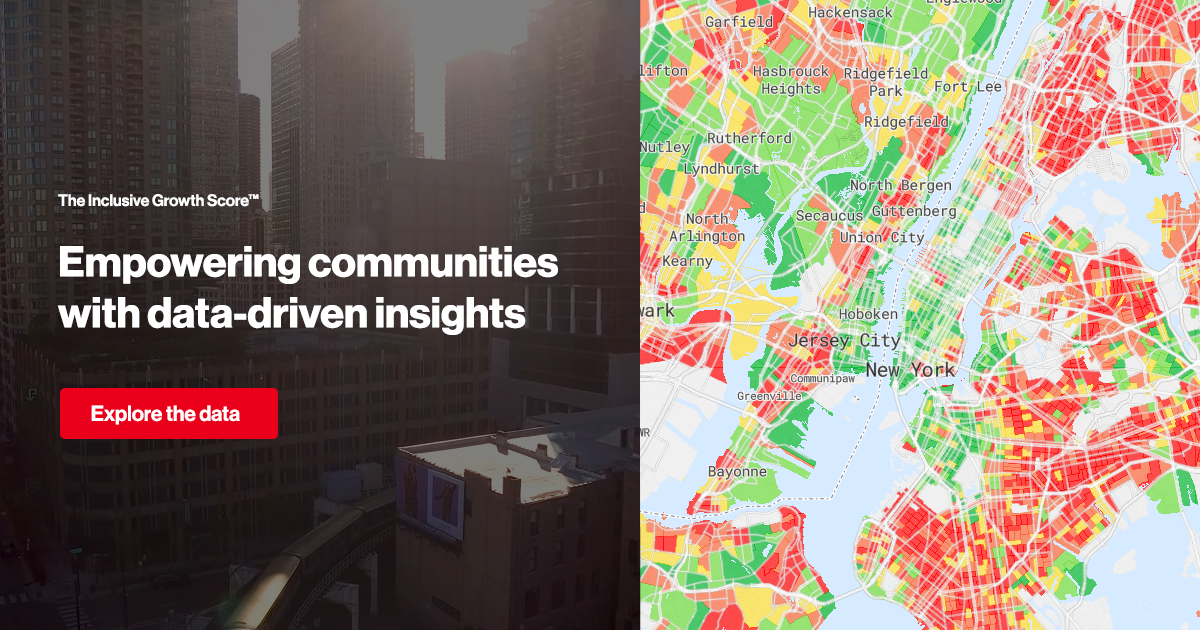
A prime example of this approach is the Inclusive Growth Score™, which successfully blends open-source census data with highly aggregated and anonymized transaction data to provide comprehensive neighborhood intelligence. This platform demonstrates how sophisticated data integration can deliver unprecedented insights while maintaining the highest privacy standards—providing local planners, policymakers, community leaders, and impact investors with clear, simple views of social and economic indicators at the neighborhood level.
The challenge isn’t just technical—it’s organizational. Successfully implementing privacy-first community data systems requires rethinking internal processes, updating staff training programs, and often modernizing legacy infrastructure that wasn’t designed with contemporary privacy standards in mind. Organizations that approach this as a comprehensive workflow transformation, rather than just a technology upgrade, achieve far better results.
Making Data Democracy Work
The most exciting aspect of the neighborhood data revolution isn’t the technology—it’s the democratization of information that was previously available only to government agencies and large corporations.
Community organizations can now access the same analytical tools that fortune 500 companies use for site selection and market analysis. Local advocacy groups can support their policy recommendations with sophisticated economic analysis. Small-scale developers can identify opportunity zones with the same precision as major real estate investment firms.
This democratization is already producing results. Community groups using advanced neighborhood data have higher success rates in grant applications, more effective advocacy campaigns, and better outcomes in their programs. Cities with transparent data platforms see increased civic engagement and more collaborative planning processes.
But realizing these benefits requires more than just access to new tools—it demands a fundamental shift in how organizations operate. The most successful implementations involve comprehensive workflow modernization: updating data collection methods, retraining staff on analytical techniques, and restructuring decision-making processes to incorporate real-time insights. Organizations that treat this as a holistic transformation rather than a simple technology adoption see dramatically better outcomes.
But making data democracy work requires more than just open datasets—it requires thoughtful design that makes complex information accessible to non-technical users. The best neighborhood data platforms feel more like social media than statistical software, with intuitive interfaces that encourage exploration and discovery.
Achieving this level of usability requires deep collaboration between technical developers and end users throughout the design and implementation process. Successful projects involve extensive user research, iterative prototyping, and comprehensive change management to ensure new systems actually get adopted and used effectively. The technology is only as valuable as the organization’s ability to integrate it into daily workflows.
The Inclusive Growth Score™ exemplifies this user-centered approach, featuring intuitive interfaces that allow users to explore complex neighborhood data through interactive maps, compare similar communities across the country, and generate comprehensive reports—all without requiring technical expertise. The platform’s success demonstrates that sophisticated analytical capabilities can be made accessible to diverse stakeholder groups when design prioritizes user experience alongside technical functionality.
The Future of Community Intelligence
Looking ahead, neighborhood-level data platforms will become increasingly sophisticated and integrated. We’re moving toward real-time community dashboards that combine government databases, private sector insights, and citizen-generated data into comprehensive neighborhood intelligence systems.
Platforms like the Inclusive Growth Score™ are already demonstrating this future, combining multiple data sources into unified scoring systems that track both current conditions (inclusion metrics) and change over time (growth indicators). This three-pillar approach—measuring Place, Economy, and Community simultaneously—provides the kind of comprehensive neighborhood intelligence that enables truly informed decision-making.
Artificial intelligence and machine learning will play growing roles in identifying patterns and predicting outcomes. Imagine planning systems that can forecast the community impact of proposed developments, or investment platforms that can automatically identify neighborhoods poised for positive transformation.
Mobile technology will make community data even more accessible, with location-aware apps that provide residents with personalized information about their neighborhoods and allow them to contribute their own observations and priorities.
Collaborative platforms will connect stakeholders across sectors, enabling coordinated responses to community challenges that currently require months of meetings and planning.
The organizations that will lead this transformation are those that start modernizing their systems and workflows now. Rather than waiting for perfect solutions, forward-thinking agencies are partnering with experienced development teams to iteratively improve their data capabilities, learning and adapting as they build toward more sophisticated platforms.
Building Better Communities Through Better Data
The neighborhood data revolution represents more than technological progress—it’s a pathway toward more equitable, evidence-based community development. When planners, policymakers, community leaders, and investors all have access to the same high-quality information about local conditions and opportunities, they can coordinate their efforts more effectively and achieve better outcomes for residents.
The communities that embrace this transformation will have significant advantages in attracting investment, developing effective policies, and improving quality of life for their residents. Those that don’t risk being left behind as resources flow toward areas with better data infrastructure and more sophisticated planning processes.
But the technology is only as good as the commitment to using it responsibly. The goal isn’t just to gather more data about communities—it’s to ensure that data serves community needs and reflects community priorities. This requires ongoing dialogue between technical developers and community stakeholders, transparent governance processes, and genuine commitment to equity and inclusion.
The most successful transformations happen when organizations approach data modernization as a collaborative process rather than a technology procurement project. Working with experienced partners who understand both the technical complexities and the organizational challenges can mean the difference between a system that sits unused and one that fundamentally changes how decisions get made.
The future of community development is data-driven, but it must also remain human-centered. The most successful neighborhood data platforms will be those that amplify community voices rather than replacing them, that make complex information accessible rather than more overwhelming, and that support local decision-making rather than imposing external solutions.
As we look toward 2025 and beyond, one thing is clear: the communities that thrive will be those that successfully harness the power of hyperlocal data to create more inclusive, sustainable, and resilient neighborhoods. The data revolution in community planning isn’t coming—it’s already here. The question is whether your community is ready to participate.
Ready to modernize your community data systems and workflows? The transformation doesn’t have to happen overnight, but it does need to start with a clear vision and experienced partners who understand both the technical possibilities and the organizational realities of change management in the public sector.
Interested in learning how neighborhood-level data visualization can transform your community planning efforts? Contact us to discover our proven approach to modernizing data workflows and building platforms that make complex intelligence accessible, actionable, and impactful.